
22 Meaning in the Bible points to one of the most fascinating numbers in Scripture a number tied to the Hebrew alphabet, the structure of the Book of Revelation, and the story of two very different kings. If you keep noticing the number 22 in your prayer life, on the clock, or in a passage of Scripture, you are not imagining things.
This number shows up again and again at pivotal moments in the biblical story, and understanding it can add real depth to how you read God’s Word.
In this guide, we will walk through the Hebrew evidence, the prophetic pattern that runs from Psalm 22 to Revelation 22, the two kings who each reigned for 22 years, and what this number might mean for your own spiritual walk. Every section is built on Scripture, Hebrew word studies, and historical context not guesswork.
What Does the Number 22 Mean in the Bible? Three Pillars
Before diving into the details, it helps to see the big picture. Biblical scholars who study numerology generally agree that the 22 Meaning in the Bible rests on three foundational pillars:
- Completion of Revelation: The Hebrew alphabet, the building blocks of nearly the entire Old Testament, contains exactly 22 letters. This links the number to the idea of God’s Word being fully expressed.
- Divine Order (or its absence): Because 22 is a multiple of 11, a number often connected with disorder, 22 can represent either the taming of chaos through godly leadership or the deepening of chaos through rebellion.
- Prophetic Completion: The final book of the Bible, Revelation, is composed of 22 chapters, closing the biblical narrative that began in Genesis.
Together, these three pillars form the backbone of the 22 Meaning in the Bible, and every example we explore below traces back to one of them.
What Does 22 Mean in the Bible? Key Facts at a Glance
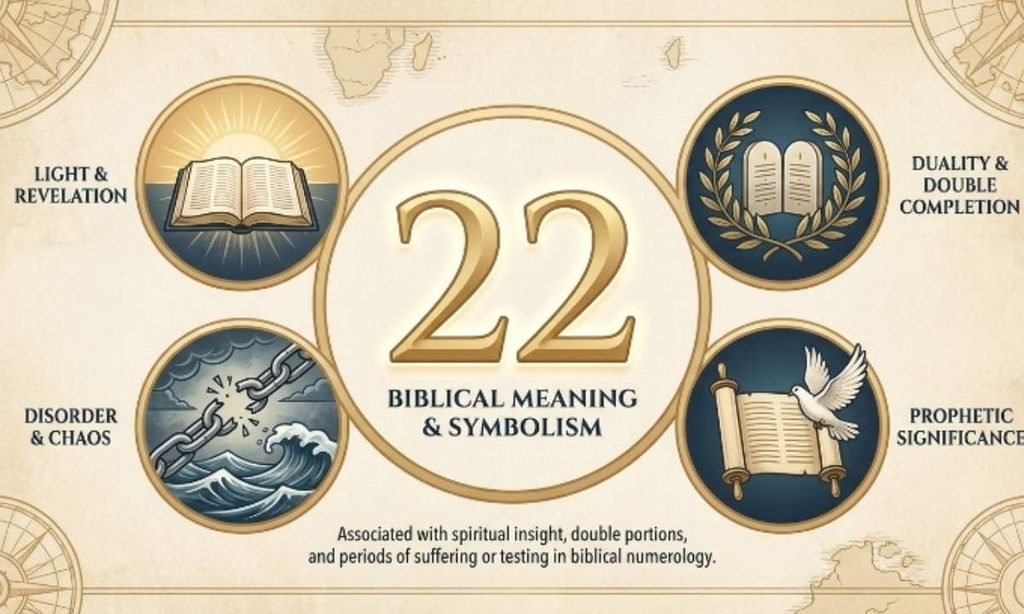
For readers who want the short version first, here is a quick-reference table summarizing the core biblical facts connected to the number 22.
| Category | Biblical Fact | Reference |
| Hebrew Alphabet | 22 letters form the entire Hebrew language | Foundation of the Old Testament |
| Tabernacle Menorah | 22 almond blossoms decorated the lampstand | Exodus 25:31-34 |
| Psalm 119 | Divided into 22 stanzas, one per Hebrew letter | Psalm 119 |
| Book of Revelation | Contains exactly 22 chapters | Revelation 1–22 |
| King Jair | Judged Israel for 22 years, bringing order | Judges 10:3 |
| King Jeroboam I | Reigned 22 years, leading Israel into idolatry | 1 Kings 14:20 |
| Psalm 22 | Prophetic psalm of suffering, quoted by Jesus | Psalm 22:1; Matthew 27:46 |
| John’s Gospel | Word “light” (phos) appears 22 times | John 8:12 |
This table alone captures much of the 22 Meaning in the Bible, but the real depth comes from examining each of these examples individually.
The Hebrew Evidence: The 22-Letter “DNA” of Creation
The clearest starting point for the 22 Meaning in the Bible is language itself. The Hebrew alphabet from Aleph to Tav contains 22 letters, and Jewish tradition has long treated these letters as more than mere symbols. They are viewed as the spiritual building blocks God used to speak the universe into existence.
Genesis 1 records God speaking creation into being ten times (“And God said…”), and Jewish scholars have long noted that the 22 letters are considered the raw material of every word God ever spoke. In this sense, the Hebrew alphabet functions almost like a spiritual genetic code the “DNA” of Scripture itself.
The Aleph-Tav Connection
Aleph is the first letter of the Hebrew alphabet; Tav is the last. Together, “Aleph-Tav” brackets the entire alphabet, much the way Jesus describes Himself as “the Alpha and the Omega, the beginning and the end” in Revelation 22:13.
While Alpha and Omega are Greek letters, the concept mirrors the Hebrew Aleph-Tav pairing precisely, reinforcing the 22 Meaning in the Bible as a symbol of totality everything from start to finish held in God’s hand.
Many Hebrew scholars also point out that the untranslated Hebrew particle “et” (אֵת), spelled with Aleph and Tav, appears throughout the Old Testament as a grammatical marker with no direct English equivalent yet it quietly signals completeness every time it is used.
Case Study: The Structure of Psalm 119
No passage illustrates the 22 Meaning in the Bible better than Psalm 119, the longest chapter in Scripture. This psalm is structured as an acrostic:
- It contains 22 stanzas, one for each letter of the Hebrew alphabet.
- Each stanza has 8 verses, and every verse within a stanza begins with the same Hebrew letter.
- The psalm’s overall theme is devotion to God’s law, word, and commands.
This deliberate structure is not accidental. By building the psalm around all 22 Hebrew letters, the psalmist visually and poetically declares that his praise of God’s Word is complete from A to Z, so to speak. Other partial acrostics, such as Psalm 25, Psalm 34, and Lamentations, follow a similar 22-letter framework, further reinforcing this pattern throughout Scripture.
The Menorah Math: 22 Almond Blossoms
Another striking piece of evidence for the 22 Meaning in the Bible comes from the Tabernacle itself. Exodus 25:31-34 describes the golden menorah, the seven-branched lampstand that stood in the Holy Place. According to the detailed instructions God gave Moses, the menorah’s central shaft and six branches were decorated with a total of 22 almond-blossom cups.
Almond trees were the first to bloom in the Israelite calendar, symbolizing watchfulness and the faithfulness of God’s promises (see Jeremiah 1:11-12, where the almond branch signals that God is “watching over” His word to perform it). With exactly 22 almond blossoms adorning the source of light in the Tabernacle, the menorah becomes a physical, three-dimensional picture of the same truth found in the Hebrew alphabet: light, structure, and divine communication converging on the number 22.
This is one of the clearest Old Testament pictures supporting the 22 Meaning in the Bible as a number of illumination and divinely ordered structure.
The Prophetic Arc: From Psalm 22 to Revelation 22
Perhaps the most powerful demonstration of the 22 Meaning in the Bible is the prophetic bookend formed by Psalm 22 and Revelation 22 two passages separated by roughly a thousand years of biblical history, yet linked by the same number and the same central figure: the Messiah.
Psalm 22: The Suffering Servant
Psalm 22, written by King David, opens with the haunting cry, “My God, my God, why have you forsaken me?” words Jesus spoke word-for-word from the cross (Matthew 27:46). The psalm goes on to describe, with startling accuracy centuries before crucifixion existed as a punishment, pierced hands and feet, divided garments, and mockery from onlookers.
Psalm 22 depicts the Messiah in His lowest, most vulnerable state: rejected, suffering, and seemingly abandoned. It is a psalm of humiliation before exaltation, sorrow before glory.
Revelation 22: The Glorified King
Revelation 22, the final chapter of the entire Bible, presents the opposite image. Here, the suffering servant of Psalm 22 has become the glorified King, seated on His throne in the New Jerusalem. The river of life flows from that throne, the tree of life bears fruit for the healing of the nations, and Jesus declares, “I am the Alpha and the Omega, the first and the last.”
Placing these two chapters side by side reveals a breathtaking pattern:
| Aspect | Psalm 22 | Revelation 22 |
| State of the Messiah | Suffering and forsaken | Glorified and reigning |
| Setting | The cross | The New Jerusalem |
| Tone | Lament and anguish | Worship and celebration |
| Key Symbol | Pierced hands and feet | The tree of life |
| Outcome | Death | Eternal life |
This arc from the cross of Psalm 22 to the throne of Revelation 22 is one of the most compelling arguments for the 22 Meaning in the Bible as a number connected to the full scope of redemption: suffering, then glory.
What does the number 22 symbolize biblically?
Biblically, the number 22 most often symbolizes completeness of revelation. Because it mirrors the 22 letters of the Hebrew alphabet, it represents the idea that God has fully spoken and fully revealed Himself through His Word. Depending on context, it can also symbolize order overcoming chaos, since it doubles the number 11, which is traditionally associated with disorganization.
What does the number 22 represent spiritually?
Spiritually, many believers interpret the 22 Meaning in the Bible as a nudge to return to Scripture, build a firmer spiritual foundation, and trust that God’s plans like His Word are complete and will come to pass. Seeing this number repeatedly is often understood as an invitation to deeper study and structured faith rather than a random coincidence.
22 Biblical meaning Strong’s Concordance
Strong’s Concordance does not assign a single Hebrew or Greek word directly to the number 22 in the way it does for words like “grace” or “faith,” since 22 is a compound number (20 + 2) in Hebrew numbering.
However, related word studies such as the Hebrew word for “light” (or) and the letters Aleph and Tav are frequently cross-referenced by numerology writers when discussing the 22 Meaning in the Bible, since these concepts appear alongside the number throughout Scripture.
What does the prophetic number 22 represent in the Bible?
Prophetically, 22 represents the completion of God’s revealed plan. This is most visible in the Book of Revelation’s 22 chapters, which close out the prophetic narrative of Scripture, and in the symmetry between Psalm 22 and Revelation 22 the suffering Messiah and the reigning King.
What is the Bible verse associated with 22?
Several verses are commonly cited, but Psalm 119, Psalm 22:1, and Revelation 22:13 are the three most frequently referenced passages when people search for the 22 Meaning in the Bible, since each one demonstrates a different dimension of the number’s significance structure, suffering, and eternal completeness.
Other Notable Appearances of the Number 22 in Scripture
Beyond the Hebrew alphabet, the menorah, and the Psalm 22–Revelation 22 arc, the number 22 quietly surfaces in several other places throughout the biblical record. These additional appearances add further weight to the idea that 22 is not a coincidence but a recurring pattern woven into the text.
- Ahaziah’s age: 2 Chronicles 22:2 records that King Ahaziah was twenty-two years old when he began to reign in Jerusalem, a detail tied directly to the number itself.
- Ahab’s reign: 1 Kings 16:29 notes that Ahab, one of Israel’s most infamous kings, reigned over Israel in Samaria for twenty-two years, echoing the same “chaos” pattern seen later with Jeroboam.
- Generations from Adam to Jacob: Some genealogical counts place 22 generations between Adam and Jacob, bridging creation to the formation of the twelve tribes.
- The Old Testament canon: According to the first-century historian Josephus, the Hebrew Scriptures were traditionally counted as 22 sacred books, matching the 22 letters used to write them.
- Repeated phrasing in the King James Version: The phrases “twenty and two” and “two and twenty” appear roughly 25 times across the Old Testament, most frequently in 1 Chronicles, Numbers, 1 Kings, 2 Chronicles, and Nehemiah.
Taken together, these details show that the number 22 is not confined to one book or one theme. It threads through genealogy, kingship, canon formation, and covenant history, reinforcing why so many Bible students continue to study its significance today.
The Tale of Two Kings: Governance or Chaos?
One of the most instructive ways to understand the 22 Meaning in the Bible is to compare two kings who each reigned for exactly 22 years yet left behind completely opposite legacies.
Jair: The Righteous Judge (Order)
Judges 10:3 tells us that Jair the Gileadite “judged Israel twenty and two years.” During his rule, Israel experienced peace and stability. His 30 sons rode 30 donkeys and governed 30 towns, a picture of organized, functioning leadership. Under Jair, the number 22 produced order, structure, and calm governance the positive expression of the 22 Meaning in the Bible.
Jeroboam: The Idolater (Chaos)
By contrast, 1 Kings 14:20 records that Jeroboam I, the first king of the northern kingdom of Israel, “reigned two and twenty years.” Rather than leading Israel toward God, Jeroboam set up golden calves at Bethel and Dan, leading the nation into generations of idolatry. His 22-year reign produced entrenched rebellion instead of order the negative, chaotic expression of the same number.
| King | Reign Length | Outcome | Symbolic Meaning |
| Jair | 22 years | Peace, order, 30 sons ruling 30 cities | Mastery over chaos |
| Jeroboam I | 22 years | Idolatry, division, generational sin | Entrenchment of chaos |
This “tale of two kings” shows that the 22 Meaning in the Bible is not fixed to a single, simplistic interpretation. Instead, it reflects a choice: the same number of years under godly leadership produced order, while under ungodly leadership it produced chaos.
What Does 22 Mean in Different Contexts?
The 22 Meaning in the Bible shifts slightly depending on where and how the number appears. Here is a breakdown of its meaning across different biblical contexts:
- In Scripture structure: completeness and organized revelation (Psalm 119, the Hebrew alphabet)
- In prophecy: the full arc from suffering to glory (Psalm 22 to Revelation 22)
- In kingship and leadership: a test of whether authority produces order or chaos (Jair vs. Jeroboam)
- In worship: light and divine presence (the menorah’s 22 almond blossoms)
- In personal application: an invitation to build, structure, and strengthen one’s spiritual foundation
The Architect’s Number
Because of its strong ties to structure the alphabet, the menorah, Psalm 119’s stanzas, and Revelation’s chapters many teachers refer to 22 as “the architect’s number.” It represents the framework God uses to build something lasting, whether that is language, worship, prophecy, or a person’s character.
Just as an architect needs a complete set of blueprints before construction begins, the 22 Meaning in the Bible suggests that God’s revelation gives believers everything they need to build a life of faith.
Continue Exploring the Biblical Number Series
If the 22 Meaning in the Bible resonated with you, biblical numerology offers a rich field of study beyond this single number. Related numbers worth exploring include:
- The number 7 — divine perfection and rest
- The number 12 — governmental authority and the tribes of Israel
- The number 40 — testing, trial, and transition
- The number 3 — divine completeness and resurrection
- The number 11 — disorder, transition, and imperfection (the root of 22)
Studying these numbers together gives a fuller picture of how Scripture uses recurring patterns to communicate spiritual truth.
Why This Pattern Still Matters Today
Numbers in Scripture are never included by accident. Every genealogy, every reign length, every acrostic psalm reflects a level of intentional design that ancient scribes preserved with remarkable care over thousands of years.
When a number like 22 shows up at the start of the alphabet’s use, in the middle of the Tabernacle’s furniture, and at both the opening lament and the closing celebration of the Messiah’s story, it is reasonable to see it as more than a mathematical curiosity.
For modern readers, this pattern offers a practical takeaway: God’s Word is not scattered or incomplete. It is arranged, intentional, and whole much like the 22 letters that form every sentence of the Hebrew Bible. Recognizing this can encourage a more careful, attentive approach to reading Scripture, paying attention not just to what is said, but to how it is structured.
Frequently Asked Questions
What is the biblical meaning of the number 22?
The biblical meaning of 22 centers on completeness of revelation, drawn primarily from the 22 letters of the Hebrew alphabet and the 22 chapters of Revelation.
Why is the number 22 considered significant in the Bible?
It is significant because it appears at structurally important points the Hebrew alphabet, Psalm 119, the menorah, and two kings who each reigned exactly 22 years.
Does 22 always have a positive meaning in Scripture?
No. Because it doubles the number 11 (disorder), 22 can represent either order, as with King Jair, or deepened chaos, as with King Jeroboam.
What does seeing 22:22 mean spiritually?
Many believers take it as an encouragement to seek God’s wisdom, study Scripture more deeply, and trust His completed plan for their life.
How many letters are in the Hebrew alphabet?
There are 22 letters in the Hebrew alphabet, forming the linguistic foundation of most of the Old Testament.
How many chapters are in the Book of Revelation?
Revelation contains exactly 22 chapters, closing the biblical narrative with the vision of the New Jerusalem.
What is the connection between Psalm 22 and Revelation 22?
Psalm 22 depicts the Messiah’s suffering, while Revelation 22 depicts His glory and reign, together forming a complete prophetic arc.
Which two biblical kings reigned for 22 years?
Jair the Gileadite and Jeroboam I of Israel both reigned for 22 years, with opposite outcomes of order and chaos.
What does the number 22 mean in numerology versus the Bible?
Secular numerology treats 22 as a “master builder” number of large-scale achievement, while the Bible ties it more specifically to God’s Word, revelation, and structured leadership.
Conclusion
The 22 Meaning in the Bible is far richer than a single definition. It is woven into the very language of Scripture through the 22-letter Hebrew alphabet, pictured in the Tabernacle through the menorah’s 22 almond blossoms, structured into the praise of Psalm 119, and stretched across the entire biblical narrative from the suffering of Psalm 22 to the glory of Revelation 22.
It also serves as a sobering reminder through the contrasting reigns of Jair and Jeroboam that the same number can produce very different outcomes depending on whether it is submitted to God’s order or twisted into rebellion.
Whatever brought you to search for the 22 Meaning in the Bible whether it was a repeated glance at the clock, a Bible study question, or simple curiosity the underlying invitation is the same one Scripture has always extended: to build your life on a complete, trustworthy foundation of God’s Word.
