
Millions of believers turn to Archangel Michael when life feels heavy, uncertain, or spiritually unsafe. The 7 Swords of St. Michael devotion has become one of the most searched Catholic prayers online, offering a structured way to ask for courage, clarity, and divine protection.
This guide explains where the devotion came from, what each sword truly represents, and how everyday believers use it to strengthen their faith. You will also find a step by step prayer method, comparison tables, and honest answers to the questions people ask most about this powerful spiritual practice.
Who Is St. Michael the Archangel?
St. Michael is described in Scripture and Church tradition as the leader of God’s heavenly army, the angel who cast Satan out of heaven, and the great defender of the faithful against evil. His name is not a title but a question, and that question shapes everything believers understand about his mission.
Across Jewish, Christian, and even some Islamic traditions, Michael consistently appears as a protector figure rather than a distant messenger. This shared reverence across faith communities is part of why devotions built around him, including the 7 Swords prayer, resonate with such a wide audience today.
Michael is often distinguished from other well known angels by his specific role. While Gabriel is remembered chiefly as a messenger and Raphael as a healer, Michael carries the distinct identity of a protector and warrior, which is why prayers seeking strength, courage, and defense against evil are directed to him rather than to other angelic figures.
Meaning of the Name Michael
The name Michael comes from Hebrew and translates roughly to “Who is like God.” It functions as a declaration rather than a simple label, a reminder that no power, human or demonic, can rival the authority of the Creator.
St. Michael’s Role in the Heavenly Army
Catholic tradition places Michael at the head of the celestial forces described in Revelation, where he battles the dragon and casts him down. This warrior identity is the foundation for every devotion built around his sword, including the seven swords prayer.
The Origin of the 7 Swords of St. Michael Devotion
The 7 Swords prayer is a modern devotional practice that draws its imagery from much older Catholic traditions of honoring St. Michael. Unlike ancient liturgical texts, this particular version of the prayer has spread mainly through parish prayer groups, devotional books, and online Catholic communities over the past several decades.
Because the devotion is relatively young compared to prayers like the Chaplet of St. Michael, its exact wording varies slightly from source to source.
A Devotional Prayer Rooted in Older Tradition
Devotion to St. Michael and his sword stretches back centuries in the Church, appearing in liturgical prayers, blessings, and popular piety long before the 7 Swords format existed. The seven swords structure builds on that long standing reverence by organizing it into seven distinct spiritual themes.
How the Devotion Differs From Official Church Liturgy
The 7 Swords prayer is not found in the Roman Missal or any official liturgical book, and it has not received formal Vatican approval the way some older devotions have. It remains, however, fully consistent with Catholic teaching on angels, grace, and spiritual warfare, which is why many priests permit and even encourage its private use.
Why Seven Swords? Understanding the Symbolism of the Number Seven
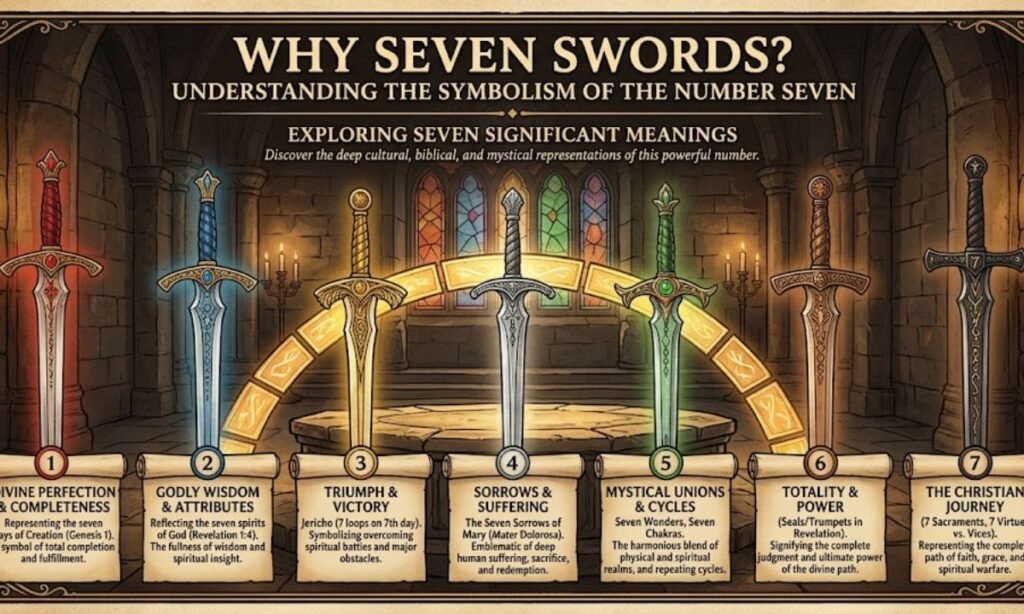
Seven appears throughout Scripture as a number connected to completeness and divine order. Seven days of creation, seven seals in Revelation, and seven sacraments all point toward the same idea that the number represents wholeness rather than randomness. Structuring the prayer around seven swords signals that the devotion is meant to cover the full range of spiritual struggle, not just one isolated problem, giving believers a complete shield rather than a partial one.
The Biblical Foundation Behind the 7 Swords Prayer
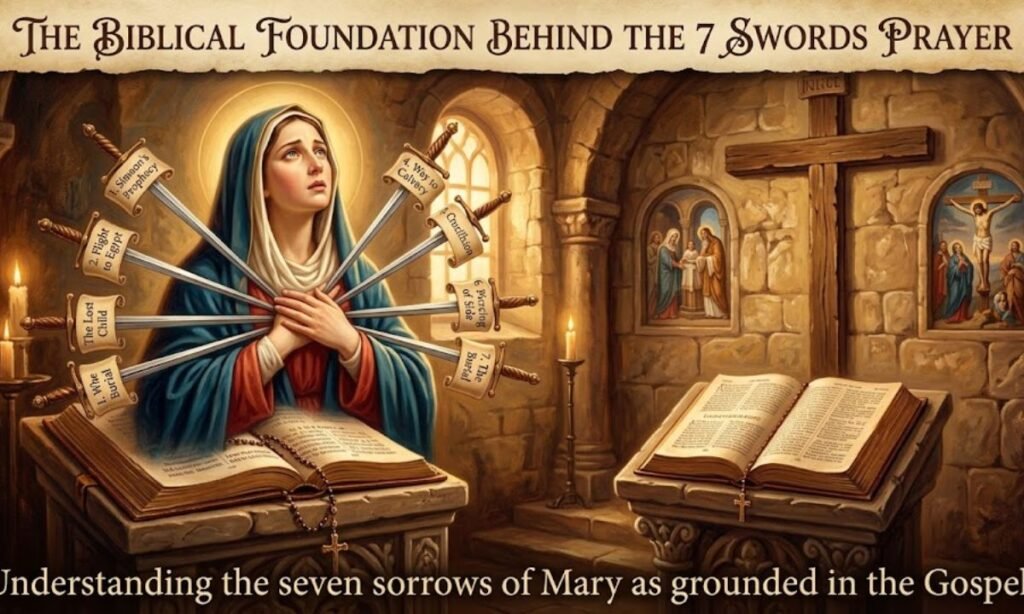
Although the 7 Swords devotion itself is not literally written in the Bible, its language and imagery draw heavily from Scripture, particularly passages describing spiritual armor and angelic warfare. Believers who pray it are encouraged to see it as an extension of biblical prayer rather than a separate tradition standing apart from Scripture.
Ephesians 6 and the Armor of God
Ephesians 6:10 to 18 describes believers putting on the full armor of God, including the sword of the Spirit, which is identified as the word of God. This passage supplies the central metaphor behind the entire seven swords tradition.
Michael’s Appearances in Daniel, Revelation, and Jude
Michael is named directly in Daniel 10:13 as a prince who fights on behalf of God’s people, in Revelation 12:7 as the leader who battles the dragon, and in Jude 1:9 disputing with the devil over the body of Moses. These three passages form the scriptural backbone believers point to when explaining why Michael is called upon for protection.
What Does a Sword Symbolize in Christian Spirituality?
A sword in Christian symbolism rarely represents literal violence. It stands instead for cutting through confusion, defending truth, and separating good from evil with precision. Understanding this distinction is essential before praying the devotion, since it prevents the prayer from being misread as aggressive or violent in intent.
The Sword as the Word of God
Hebrews 4:12 describes the word of God as sharper than any two edged sword, able to divide soul and spirit. This image directly informs how believers understand each of the seven swords, treating them as spiritual instruments rather than weapons of harm.
Spiritual Weapons Versus Physical Weapons
Every sword in this devotion is understood as a grace, not a blade. Believers are not asking for the ability to harm anyone; they are asking for interior strength, moral clarity, and protection from unseen spiritual attack.
This distinction matters for anyone introducing the devotion to children or newcomers, since the martial language of swords and battle can otherwise sound alarming out of context. Framing each sword clearly as a virtue rather than a weapon helps keep the prayer centered on personal growth and trust in God rather than on conflict or fear.
Related Post: 85+ Heartfelt Belated Birthday Wishes for Sister to Make Her Smile (2026)
The First Sword: The Sword of Humility
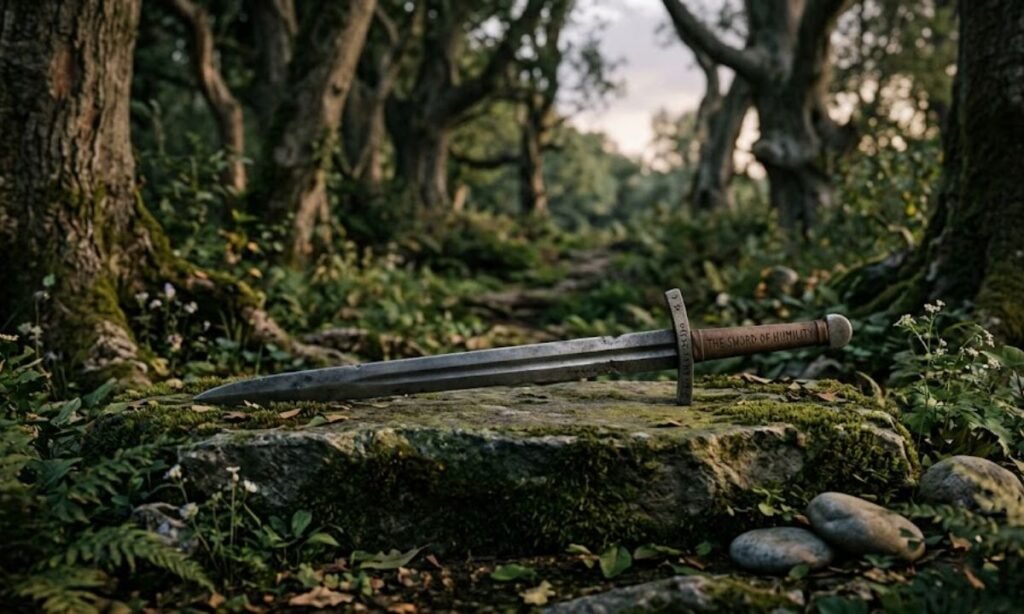
The first sword asks St. Michael to help the believer recognize human limitation and total dependence on God, cutting away pride and vanity that can quietly damage the soul. Many devotional writers describe pride as the root cause behind nearly every other spiritual struggle, which is why this sword opens the entire prayer rather than appearing later in the sequence.
What This Sword Teaches
Humility is presented as the starting point of the entire devotion because pride is often the first opening that spiritual struggle exploits. Without humility, the remaining six swords lose much of their strength.
How Humility Protects the Soul
By asking for humility first, believers set an honest foundation for everything that follows, admitting weakness instead of projecting false confidence, which many spiritual writers describe as the safest possible starting point for prayer.
Spiritual directors often note that humility is not the same as low self worth. Instead, it is an accurate view of oneself in relation to God, neither inflating personal ability nor dismissing personal dignity.
The Second Sword: The Sword of Prudence and Discernment
The second sword calls on prudence, the light that allows a person to separate right from wrong and to make decisions that genuinely reflect God’s will rather than fear, pressure, or impulse. Believers often pray this sword before making a major life decision, asking for a clear mind free of confusion or manipulation.
The Third Sword: The Sword of Patience
The third sword asks for the grace to carry life’s trials the way Christ carried His cross, with steadiness rather than resentment. Patience in this context is not passive waiting but active endurance, a willingness to keep moving forward through hardship without losing faith.
This sword is frequently prayed during long seasons of illness, financial strain, or family conflict, when the temptation to give up feels strongest.
The Fourth Sword: The Sword of Deliverance
The fourth sword focuses on freedom, asking St. Michael to break the hold of fear, addiction, harmful habits, or emotional bondage that keeps a person spiritually stuck. This sword speaks directly to anyone who feels trapped by a pattern they cannot break alone, offering language that treats deliverance as an act of grace rather than a personal failure to fix through willpower.
The Fifth Sword: The Sword of Truth
The fifth sword asks for clarity to see through deception, manipulation, and the confusing messages of a noisy world, guiding believers toward decisions rooted in honesty rather than illusion. In an age shaped by misinformation and constant digital noise, this sword resonates strongly with people seeking a stable sense of what is actually real and trustworthy.
The Sixth Sword: The Sword of Encouragement and Protection
The sixth sword brings together comfort during emotional hardship with a request for protection over the believer’s home, family, and daily life. It functions almost like two swords joined into one, addressing both the inner emotional world and the outer physical environment a person lives in.
Comfort During Sorrow and Loneliness
This sword is often prayed by people facing grief, isolation, or discouragement, asking St. Michael to renew hope and remind the soul that suffering is not the final word.
Guarding the Home and Family
Believers also use this sword to ask for safety over their household, protection from harmful outside influences, and peace within family relationships that may be under strain.
Parents in particular often adapt the sixth sword into a nightly blessing over their children, asking St. Michael to stand watch over the home while the family sleeps. This practical, everyday use is part of why the sixth sword is one of the most frequently shared portions of the devotion in family prayer groups and parenting focused faith communities.
The Seventh Sword: The Sword of Victory Over Death
The final sword confronts the deepest human fear directly, asking St. Michael, who in Catholic tradition escorts souls at the hour of death, to remind the believer that death does not have the final word.
It draws on 1 Corinthians 15:55, which boldly asks where death’s victory has gone, and it is commonly prayed for the dying, for grieving families, or by anyone wrestling with mortality, offering a sense of peace grounded in the promise of eternal life rather than denial of death itself.
The Seven Swords at a Glance
The table below summarizes each sword, its core theme, and a short scriptural reference commonly associated with it, giving readers a quick reference they can return to during prayer.
| Relationship Style | Recommended Tone | Example Style |
| Close and casual | Funny or short | Joking references, inside jokes |
| Traditional or formal | Heartfelt or religious | Respectful, grateful wording |
| Long distance | Emotional | Focused on connection despite distance |
| Social media post | Short and catchy | Caption style with minimal text |
How to Read the Table
Each row can be treated as a standalone meditation. Believers who cannot pray the full devotion in one sitting often choose a single sword that matches their current struggle and return to the rest later, using the table as a quick reminder of which sword fits which situation.
Related Post: 120+ Good Morning Daughter Wishes to Express Your Love
How the 7 Swords Prayer Differs From the Chaplet of St. Michael
Although both devotions honor the same archangel, they are structured very differently and come from separate historical roots. Confusing the two is common, so understanding their differences helps believers choose the right devotion for their spiritual goals.
The Nine Choirs Chaplet Explained
The older Chaplet of St. Michael traces back to Antonia d’Astonac, a Carmelite nun who reported a vision of the archangel instructing her to offer nine salutations to the nine choirs of angels. Pope Pius IX approved this chaplet in 1851, giving it a level of formal recognition the 7 Swords devotion does not currently hold.
Two Devotions, One Purpose
Both prayers exist to draw believers closer to Michael’s protection, but the chaplet follows a fixed, historically documented structure with papal approval, while the 7 Swords prayer is a newer, more flexible devotion focused on personal virtues rather than the angelic hierarchy.
Preparing Your Heart and Space Before Praying
Preparation matters as much as the words themselves. A calm, intentional environment helps the mind focus and treats the prayer as a genuine act of faith rather than a rushed routine.
Creating a Quiet Sacred Space
Choose a space free of distraction, whether that means a home altar, a quiet bedroom corner, or a church pew before or after Mass. Silence allows each sword to be considered slowly instead of read on autopilot.
Items That Can Support Your Prayer
Many believers hold a rosary, crucifix, or small bottle of holy water while praying, not because these objects hold magical power, but because physical touch can help anchor attention during meditation and prayer.
A brief examination of conscience before beginning can also make the devotion more effective, giving the believer a clear sense of which struggles are most pressing that day. Some choose to light a candle as a simple visual marker that the time set aside is sacred and separate from ordinary daily activity, helping the mind transition into a more reflective state before the first sword is even read.
A Step by Step Guide to Praying the 7 Swords of St. Michael
Following a clear structure makes the devotion easier to sustain over time, especially for beginners who are new to structured Catholic prayer.
Step One Through Three
Begin with the Sign of the Cross, take a moment of silence to settle the mind, then read the first sword slowly, pausing to reflect on humility before moving to the second sword focused on discernment and the third focused on patience.
Step Four Through Seven
Continue through deliverance, truth, and encouragement, pausing briefly after each one to consider how that specific grace applies to your current life, then close with the seventh sword on victory over death, allowing extra time for reflection since this final sword often carries the most emotional weight.
Closing the Prayer
Finish with a personal prayer of thanks, asking St. Michael to carry these intentions before God, then close again with the Sign of the Cross. Some believers add a brief moment of silent listening at this point, treating the closing as an invitation to notice any sense of peace or clarity that follows the prayer.
New believers sometimes worry about getting the order or wording wrong, but spiritual directors generally encourage flexibility over rigid precision. What matters most is that each sword is prayed with attention and honesty, not that every step follows an identical script each time it is prayed.
Sample Wording for Each of the Seven Swords
Believers do not need to memorize a rigid script. A simple, honest structure works well: name the sword, state its meaning in your own words, then ask St. Michael for that specific grace. For example, a believer might pray, “By the sword of truth, St. Michael, help me see clearly and reject every deception placed in my path today.”
This format keeps the prayer personal and prevents it from feeling mechanical, and it also makes the devotion easier to teach to children or newcomers who may feel intimidated by longer traditional prayers.
Adapting the Words to Your Own Situation
Feel free to adjust the wording to match a specific need, such as a job decision, a health scare, or a family conflict, while keeping the core theme of each sword intact.
The Best Times to Pray the 7 Swords
Timing can shape how meaningful the devotion feels, though there is no single required schedule, and believers are free to build a rhythm that fits their own life.
Morning and Evening Devotion
Many believers pray the full set in the morning to set spiritual intentions for the day, or in the evening as a way to release the day’s stress before sleep.
Praying During Times of Crisis
Others turn to specific swords only when a matching struggle arises, such as praying the fourth sword during a season of addiction recovery or the sixth sword during grief.
Spiritual Benefits of the 7 Swords Devotion
Regular practice of this prayer is widely described as strengthening faith, sharpening moral clarity, and deepening a believer’s sense of connection to God through angelic intercession.
Strengthened Faith and Resilience
Believers who pray the devotion consistently often describe a steadier faith during hardship, crediting the repeated structure with keeping them anchored when circumstances feel chaotic.
A Deeper Sense of Divine Protection
The prayer reinforces the idea that spiritual protection is available at every stage of life, not only during dramatic crises but in small daily decisions as well, from ordinary temptations to larger moral choices.
Over time, many believers describe the seven swords becoming a kind of internal vocabulary for their spiritual life, so that even outside formal prayer time, they find themselves reaching instinctively for the language of a specific sword, such as asking silently for the sword of patience while stuck in a stressful moment during the workday.
Emotional and Mental Benefits of the Prayer
Beyond its spiritual dimension, many people report practical emotional benefits from the discipline of regular prayer, benefits that overlap closely with what mental health professionals often describe in structured mindfulness or gratitude practices.
Calm in Anxiety and Fear
Structured prayer of this kind gives anxious thoughts a clear outlet, replacing spiraling worry with a focused, repeatable practice that many describe as calming.
Comfort in Grief
The seventh sword in particular offers language for processing loss, giving grieving believers a way to voice fear about death within a framework of hope rather than despair.
Faith communities that incorporate structured prayer into grief support groups often find that participants feel less alone in their sorrow, since the devotion gives shared language to emotions that can otherwise feel isolating or difficult to put into words during the early stages of loss.
Comparing the 7 Swords With Other St. Michael Devotions
The table below places three popular St. Michael prayers side by side so readers can quickly see how they differ in origin, structure, and approval status.
| Devotion | Origin | Church Approval | Structure |
| 7 Swords Prayer | Modern devotional tradition | Not formally approved | Seven virtue based petitions |
| Chaplet of St. Michael | Antonia d’Astonac, 18th century | Approved by Pope Pius IX, 1851 | Nine salutations to angelic choirs |
| Prayer to St. Michael | Pope Leo XIII, 19th century | Widely used in liturgy | Single short intercessory prayer |
Choosing the Devotion That Fits Your Needs
Someone seeking a quick daily prayer may prefer the short Leo XIII prayer, while someone wanting deeper personal reflection on specific virtues may find the 7 Swords devotion more suited to their spiritual goals, and many believers simply use all three depending on the moment.
Common Misconceptions About the 7 Swords Prayer
Several myths surround this devotion, often because its popularity online has outpaced clear explanation of its actual theology, leading some newcomers to misunderstand its purpose.
It Is Not a Magic Formula
The prayer does not function like a spell or guaranteed outcome. Its power rests in sincere faith and trust in God, not in reciting exact words a fixed number of times.
The Swords Are Not Literal Weapons
Every sword described in the devotion is symbolic, representing a spiritual grace rather than an actual blade wielded against another person or spirit.
A related misconception treats the prayer as a guarantee against all hardship, as though praying it faithfully should prevent illness, loss, or difficulty entirely.
Is the 7 Swords Prayer Approved by the Catholic Church?
The devotion is not part of official Catholic liturgy and has not received formal Vatican recognition the way the Chaplet of St. Michael has.
Private Devotion Versus Official Liturgy
Because it remains consistent with Catholic teaching on angels and spiritual warfare, many priests still encourage its use as a private devotion, even without formal liturgical status, much like countless other popular prayers passed down through parish life.
Can Non-Catholics and People of Other Faiths Pray This Devotion?
Many Christians outside the Catholic Church also pray to St. Michael, since he is recognized across Orthodox, Anglican, and various Protestant traditions as a biblical figure connected to spiritual protection.
A Prayer Open to Sincere Hearts
There is no strict requirement of Catholic membership to pray the 7 Swords devotion respectfully, as long as it is approached with honest faith rather than superstition.
The Role of Faith in the Power of the Prayer
The prayer itself is only as meaningful as the faith behind it, which is why devotional writers consistently emphasize sincerity over ritual precision.
Words Alone Do Not Carry the Power
Repeating the words without genuine trust in God offers little spiritual benefit. The devotion works as an expression of faith already present in the believer’s heart, not as a substitute for that faith.
St. Michael in Art, Iconography, and Church Tradition
St. Michael has appeared in Christian art for centuries, almost always shown as a warrior figure standing over a defeated dragon or demonic figure, sword raised in triumph.
The Warrior Angel in Classic Paintings
Renaissance artists frequently depicted Michael in full armor, reinforcing his identity as a defender rather than a passive messenger angel, an image that continues to shape how believers picture him during prayer.
Statues and Symbols Found in Churches Today
Many parishes display statues of Michael near entrances or side altars, often holding scales alongside his sword, symbolizing both protection and divine justice within the same figure.
Feast days dedicated to St. Michael, celebrated in the Catholic calendar on September 29 alongside Gabriel and Raphael, also keep this visual tradition alive each year, with many parishes holding special blessings, novenas, or processions that reinforce the same imagery believers encounter in the seven swords devotion.
How the 7 Swords Devotion Has Spread in Modern Times
The devotion has grown significantly through digital platforms rather than traditional print devotionals, reaching a much wider audience than earlier generations of similar prayers.
Social Media and Online Prayer Communities
Prayer groups, faith based social accounts, and devotional blogs have introduced the 7 Swords prayer to millions of readers who might never have encountered it through a parish bulletin alone, helping it spread across American Catholic and charismatic Christian communities in particular over the last several years.
Incorporating the 7 Swords Into a Daily Spiritual Routine
Making the devotion a consistent habit tends to deepen its personal impact over time rather than treating it as a one time request during a crisis.
Journaling Alongside Each Sword
Some believers keep a small notebook, writing a short reflection after praying each sword, which helps track spiritual growth and specific answered prayers over months or years.
Praying as a Family or Group
Others pray the devotion together as a household or in a small parish prayer group, which can strengthen shared faith and provide accountability for maintaining the practice
Introducing children to the devotion often works best through simplified language, focusing on one virtue at a time rather than the full set of seven, allowing younger family members to grow into the complete prayer gradually as their understanding of faith deepens with age.
Practical Tips for Staying Consistent With the Devotion
Consistency matters more than perfection when building any prayer habit, and small practical steps can make the difference between a fleeting attempt and a lasting practice.
Setting Reminders and Building Habit
Pairing the prayer with an existing daily routine, such as morning coffee or a nightly wind down, makes it far easier to sustain than trying to remember it at a random point in the day.
What to Do When You Miss a Day
Missing a day does not undo previous prayer or reduce its meaning. Simply resuming the next day, without guilt, keeps the devotion sustainable over the long term.
Some believers keep a printed or handwritten copy of the seven swords in a wallet, car, or workspace, which makes it easier to return to the prayer during unexpected moments of stress rather than relying on memory alone. Others set a simple weekly goal, such as praying the full devotion at least three times a week, which tends to be more sustainable long term than an all or nothing daily requirement that can quickly feel discouraging if broken.
Frequently Asked Questions
What are the 7 Swords of St. Michael?
They are seven symbolic prayers representing humility, discernment, patience, deliverance, truth, encouragement, and victory over death, each asking St. Michael’s intercession for that specific grace.
Is the 7 Swords prayer part of official Catholic teaching?
It is not formally approved liturgy, but it aligns with Catholic teaching on angels and is widely used as a private devotion.
How often should I pray the 7 Swords?
There is no fixed rule. Many pray it daily, while others use it only during specific seasons of struggle.
Can I pray the 7 Swords without being Catholic?
Yes. Christians from many traditions pray to St. Michael, and the devotion can be prayed respectfully by anyone with sincere faith.
What is the difference between the 7 Swords and the Chaplet of St. Michael?
The chaplet honors the nine choirs of angels and holds papal approval from 1851, while the 7 Swords is a newer, virtue focused devotion without formal Church approval.
Do I need a chaplet or rosary to pray the 7 Swords?
No physical item is required. Some believers hold a rosary or crucifix simply to help focus their attention during prayer.
What should I do if I miss a day of prayer?
Simply continue the next day. Missing a day does not diminish the devotion or require starting over.

2 thoughts on “7 Swords of St. Michael: Meaning, Symbolism & Spiritual Significance”